Ways People Have Interpreted Art Ways People Have Interpreted Salvador Dalis Art
Ever since Dan Brown wrote The Da Vinci Code, the Net has been awash with people trying to solve the "mysteries" of great art. From aliens in Renaissance paintings to countless conspiracies involving the Mona Lisa, there's been no dumb stone left unturned.
But not all theories about a work'southward meaning are so openly nuts. Some manage to be both completely disarming and utterly mind-blowing.
ten A Satyr Mourning Over A Nymph Actually Shows A Cruel Murder
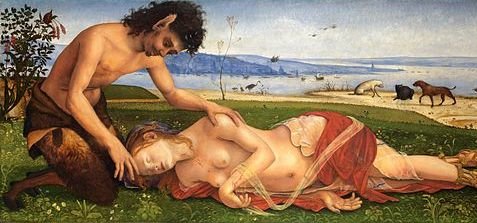
Painted past Piero di Cosimo in 1495, A Satyr Mourning Over A Nymph supposedly depicts a scene from Ovid's Metamorphoses. In that story, Procris is accidentally killed in the woods when her hunter husband Cephalus mistakes her for a wild brute and hurls a spear through her. Information technology's a typical choice of scene for a Renaissance artist, with but 1 problem. A close exam proves in that location's no fashion Cosimo's Procris could have been killed past blow.
According to British professor Michael Baum, all signs point toward the scene depicting a brutal murder. Procris has deep lacerations around her hands consistent with someone trying to fend off a pocketknife attack. Her left hand is besides aptitude backward in a position known as "the waiter's tip," typically found in murder victims who have had their cervical cord severed at points C3 and C4. Finally, there's a neck wound respective to the position of C3/C4. Rather than being a scene of romance, Cosimo'southward painting shows the backwash of a frenzied knife attack.
This probably wasn't intentional. Professor Baum suspects Cosimo asked the local morgue to loan him a corpse for the painting and only happened to go a murder victim.
ixDiego Rivera Implies J.D. Rockefeller Jr. Had Syphilis
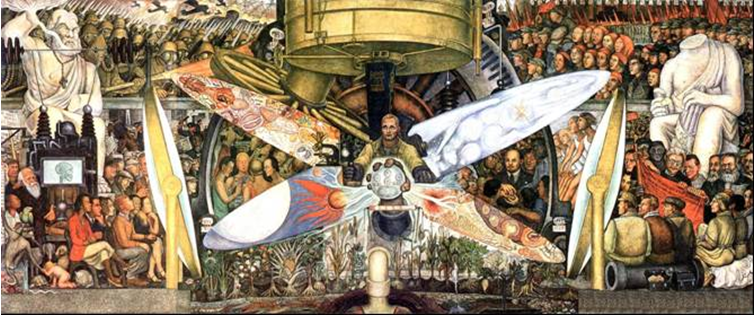
Diego Rivera'southward Man, Controller Of The Universe is one of Mexican art'southward biggest paintings—literally and figuratively. Originally deputed for the Rockefeller Centre simply reconstructed in Mexico City after Nelson Rockefeller took consequence with its depiction of Lenin and had information technology destroyed, information technology's one of the 20th century's iconic works. It's also a monumental act of revenge. The mural claims Nelson Rockefeller's father had syphilis.
One of the fundamental elements is the landscape's recreation of recent scientific discoveries. Galaxies, exploding suns, and close-ups of bacteria swarm in its key cross, floating in a higher place the heads of men and women. After Nelson Rockefeller tore down his original version, Rivera went dorsum and painted his father, J.D. Rockefeller Jr., under one of those bacteria close-ups. The bacteria he chose simply happened to be syphilis.
That wasn't all he did. Despite J.D. Rockefeller Jr. being a lifelong teetotaler, Rivera drew him with a martini and a woman who may be a prostitute. For added consequence, he stuck Lenin in a prominent position.
8 Isabella Features A Man Hiding His Erection
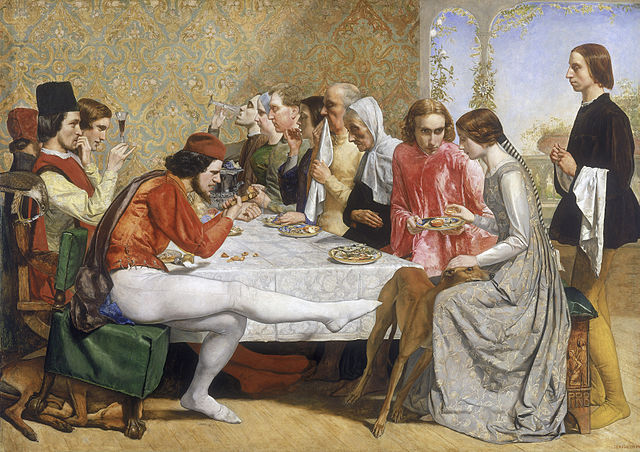
One of the leading lights of the Pre-Raphaelite movement, John Everett Millais is probably best known today for his Ophelia. At least, he was until 2012, when researchers discovered something unexpected lurking in his early painting Isabella. Featuring a bunch of characters from Boccaccio's Decameron sitting around a tabular array at a banquet, it also includes what looks unmistakably like the shadow of an erection.
The character in the foreground left of the painting is cocking one leg and using a nutcracker. If you expect closely, you tin can see the shadow bandage by the nutcracker just happens to line up perfectly with his crotch, making him wait extremely overenthusiastic about the entree. And far from being farther proof that our minds are irredeemably in the gutter, it was almost certainly intentional.
The Decameron is one of the most erotic books e'er written, and the painting is total of references to sexuality. The graphic symbol's outstretched leg is meant to exist phallic, and a pile of common salt spilled across the shadow penis probably symbolizes semen. Information technology's almost equally muddied as you tin get without merely drawing porn.
7 La Primavera Is A Love Letter To Horticulture
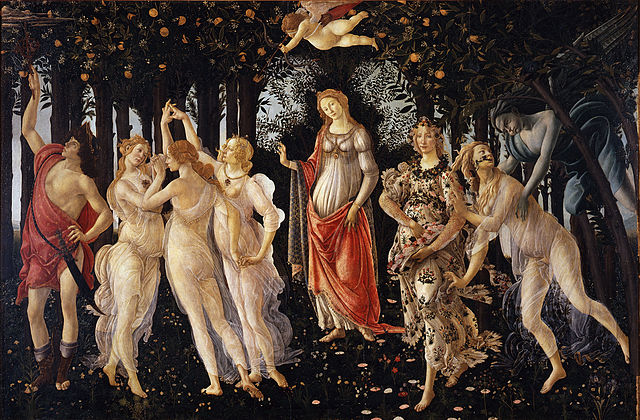
One of the about famous paintings in Florence's Uffizi Gallery (which is maxim something), Botticelli'southward La Primavera is also ane of the most mysterious. Featuring a group of women in a heaven-similar meadow, experts still argue over its allegorical meaning. Only there's one theory that stands out from all the others, in terms of evidence and strangeness—some claim it's all most horticulture.
The reasoning comes from the mind-bravado attention to detail Botticelli put into the plants in his imaginary meadow. Co-ordinate to official estimates, there are at least 500 individually identifiable plants on display, comprising nearly 200 different species. Some have suggested they represent all the plants growing effectually 15th-century Florence that flowered betwixt March and May, while others have claimed they include fantasy plants Botticelli might have fabricated up particularly for the painting.
With all this attention to flowers, some aficionados barely register the human figures standing to a higher place. Information technology's even been said that the painting represents "not then much high civilization as horticulture."
six The Music Lesson Is Kinky As Heck
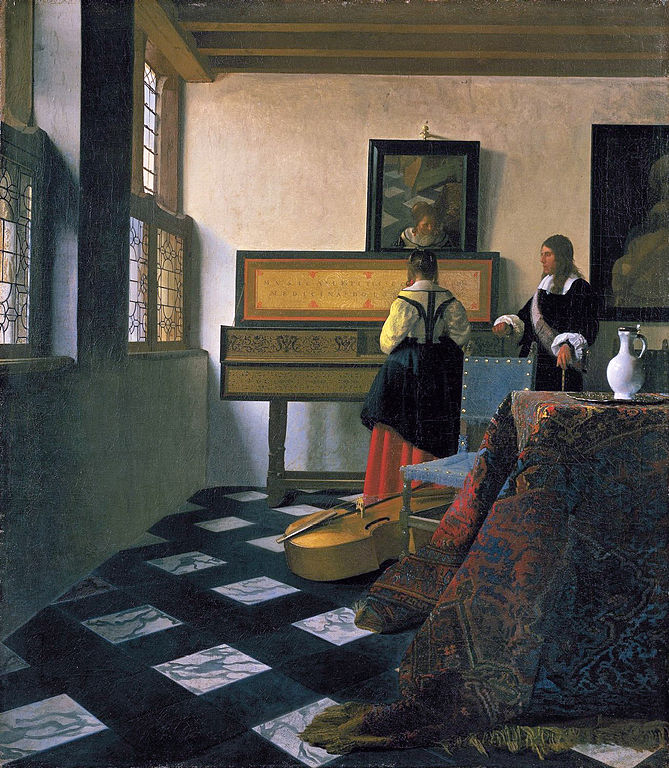
Painted by Johannes Vermeer in the 1660s, The Music Lesson is considered one of the greatest portraits of 17th-century Dutch life. Featuring a young girl being taught to play a type of harpsichord chosen a virginal by her handsome tutor, it'southward a photo-realistic delineation of a typical upper-grade day in Vermeer'due south world. At least, that's the standard explanation. Another view is that it'south all to do with sexual practice and hidden animalism.
According to this theory, the painting is filled with little clues to the raw sexual tension between the girl and her tutor. Unsurprisingly, the virginal has been associated with virginity, while the mirror above information technology reveals the girl is actually looking at the human being equally she plays, distracted by his "male presence." Behind them, the pitcher of wine is meant to suggest an aphrodisiac issue is taking place, while the instrument on the floor doubles as an enormous phallic symbol. The angle we view the painting from might even suggest the viewer is a voyeur.
It's not just this one painting. Some fine art critics fence the presence of music in Vermeer ever symbolizes sexuality, making his oeuvre deeply kinky.
5 Cafe Terrace At Night Is Virtually The Last Supper
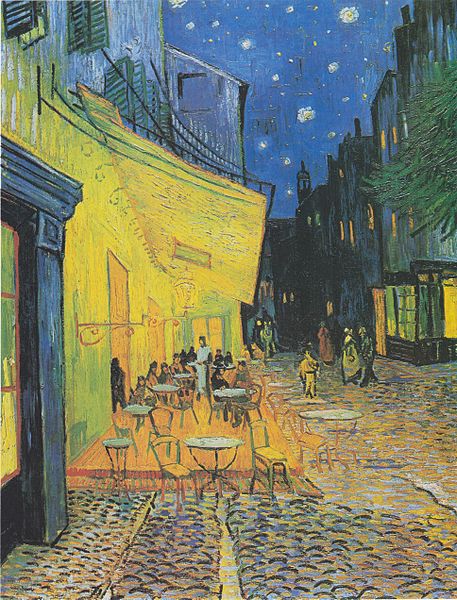
Painted in 1888, Buffet Terrace At Night is ane of Van Gogh's most important works. It's also 1 of his nearly honey, featuring a archetype Van Gogh take on an ordinary scene. Just another schoolhouse of thought claims there's something much deeper at play. Co-ordinate to a recent theory, Buffet Terrace At Night is actually most the Last Supper.
From an early on historic period, Van Gogh was extremely religious. His male parent was a Protestant minister, and influential fine art critics have argued that his paintings are suffused with Christian imagery. In the example of Cafe Terrace At Dark, that imagery comes in the class of Jesus sitting down to eat with his disciples. If you look closely at the diners, you tin come across there are 12 of them, seated around a fundamental figure with long hair. Tellingly, there'southward even a number of crosses hidden in the picture, including ane directly above the Christ figure.
There's contemporary evidence to back this claim upward. When Van Gogh wrote to his brother about the painting, he claimed the world had a "tremendous demand" for religion. He was as well deeply infatuated with Rembrandt and voiced a desire to revive his style of subtle Christian symbolism. Cafe Terrace At Night might well be proof that he ultimately succeeded.
4 An Apologue With Venus And Cupid Is Virtually Syphilis
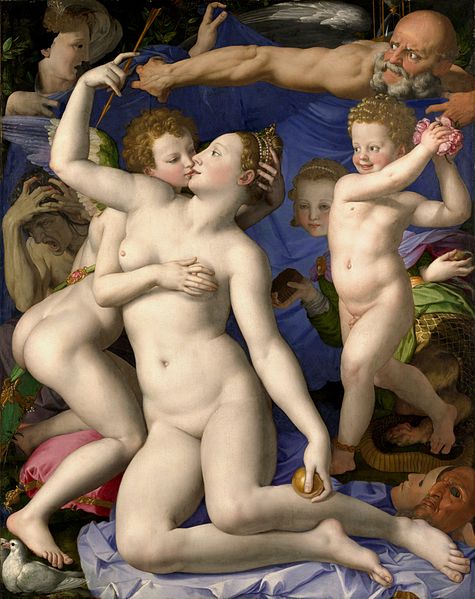
A painting that shows Venus and Cupid getting information technology on while a baldheaded guy watches and a man screams in the groundwork was e'er going to be unsettling. Even by the standards of its subject, though, Agnolo Bronzino'southward Allegory With Venus And Cupid is nighttime. Despite being described as an erotic picture "of singular beauty," there's a lot of evidence that it'south really a alarm about syphilis.
The focus of this theory is the screaming figure in the lower left of the painting. Although classically said to symbolize jealousy or despair, a close test shows they're actually very ill. Their fingers are swollen exactly as y'all'd wait in a syphilis patient, a fingernail is missing, and their pilus has signs of syphilitic alopecia. Their toothless gums fifty-fifty suggest mercury poisoning, mercury beingness the closest thing Renaissance Italy had to an STD treatment.
It gets darker. The kid showering Venus and Cupid with flowers appears to have pierced his human foot on a rose thorn without noticing. Such a lack of sensation would directly event from syphilitic myelopathy. In other words, the painting appears to show the lovers surrounded by syphilis-induced suffering; a vision of what lies in shop for them if they get carried away by passion.
iii El Motorbus Is About A Horrible Crash
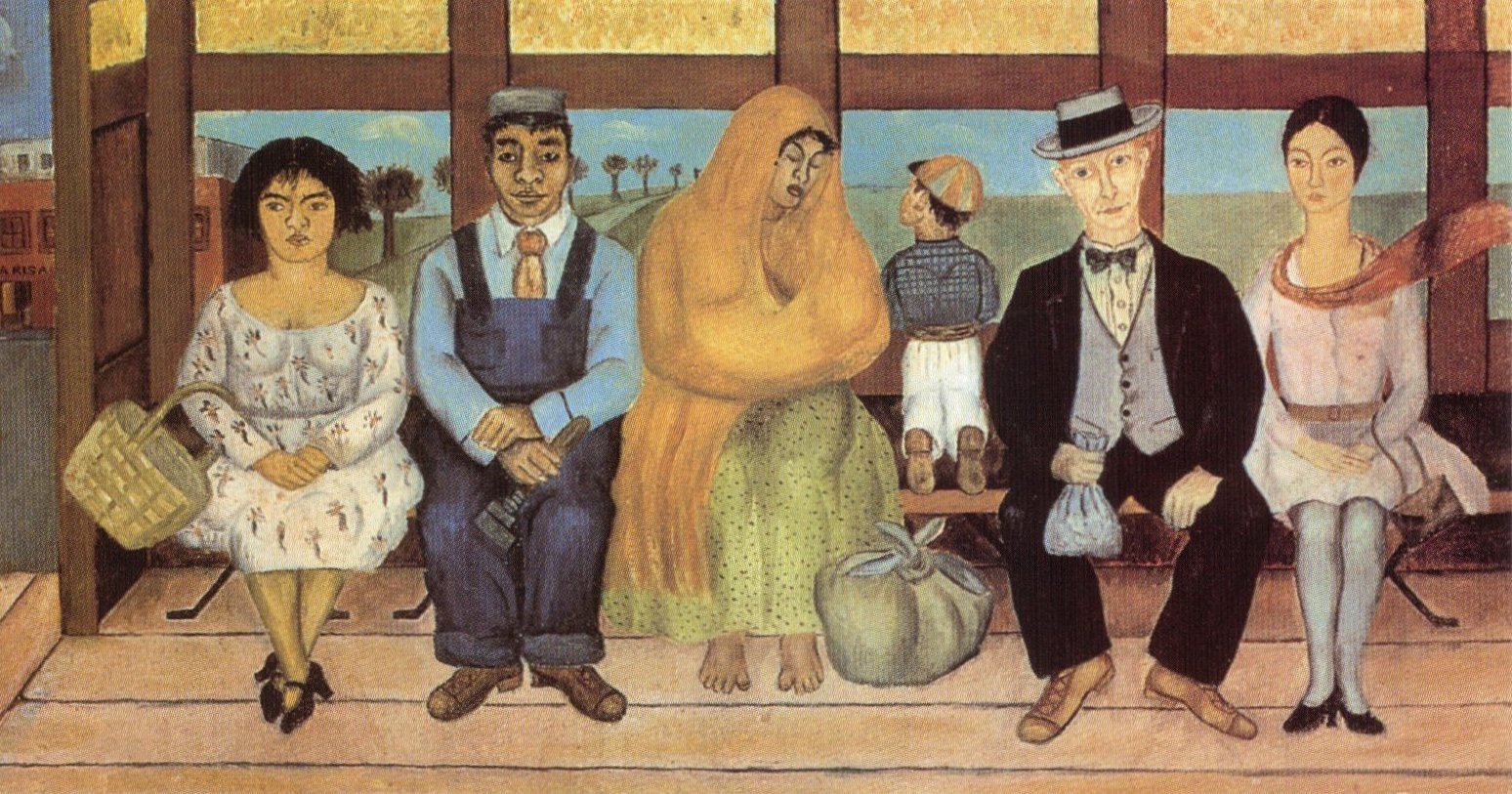
Painted past legendary Mexican artist Frida Kahlo in 1929, El Autobus is famous for showing a cantankerous-section of Mexican order living side by side. A housewife, blue-collar worker, Native American mother, and rich gringo businessman are all waiting for a bus, along with a girl who is probably meant to be Frida herself. If that'due south the case, then the painting has a much darker subtext. All of its subjects are virtually to be in a horrific accident.
In 1925, Kahlo was on a jitney that crashed headlong into a trolley car. The wreck was then bad that Kahlo was impaled on a metal handrail, leaving her in agony for the rest of her life. Her later works frequently referenced the accident, implying it was a phenomenon that she survived the crash at all. And El Omnibus is no exception. It's been suggested the blue-collar worker is meant to exist the man who saved Kahlo'due south life by pulling the handrail from her cleaved torso, meaning the painting is set merely before they boarded the bus. Far from existence on their mode home, the characters are headed straight for a trigger-happy encounter with fate.
twoThe Dutch School'south Paintings Within Paintings
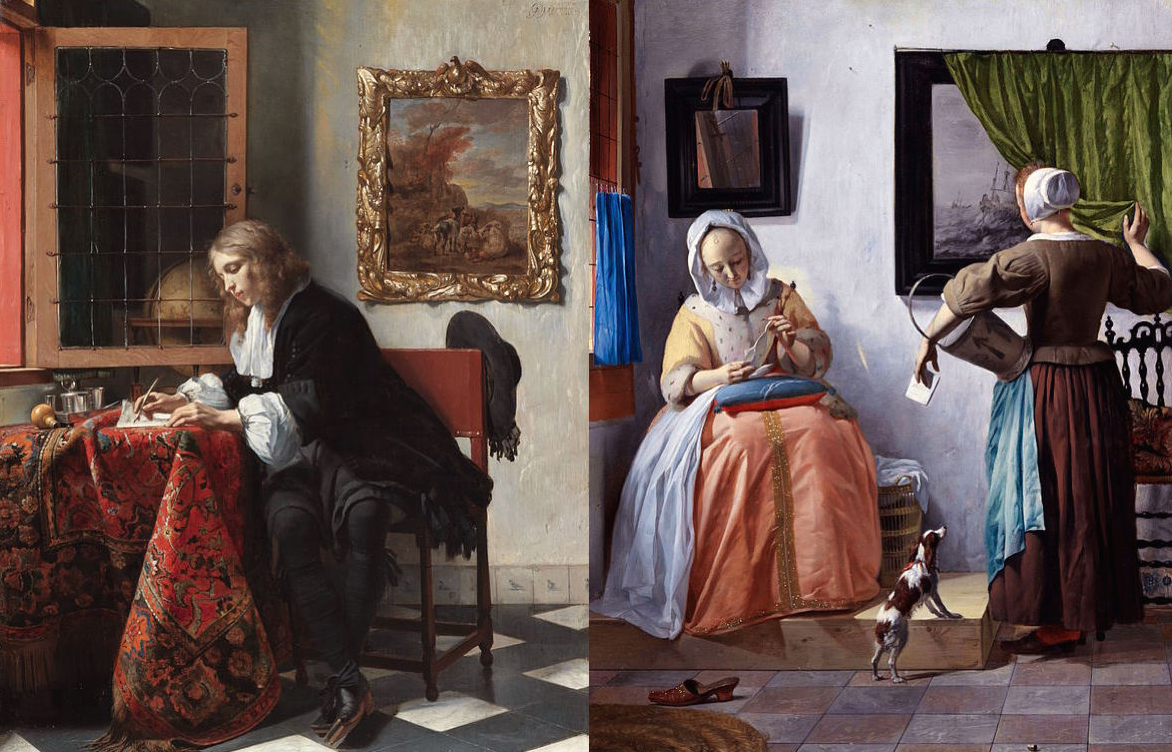
The Dutch Gilded Age of painting is 2nd just to the Italian Renaissance in stature. Like other eras, information technology had its own piddling quirks of way, like artists including other paintings in the background of their pictures. These "paintings within paintings" weren't only Vermeer and his pals showing off. They independent a special symbolic lawmaking telling you lot exactly how to read each image.
Take The Slippers by Samuel van Hoogstraten. At commencement glance, the painting shows an empty hall with two slippers lying in it, with a copy of Father Admonishing His Daughter by Caspar Netscher hanging in the background. It most seems boring. But contemporary Dutch viewers would've known that the Netscher painting takes place inside a brothel. Combined with the two slippers beingness a mismatched pair belonging to both a man and a woman, the articulate inference would've been that the hall was empty because the occupants were decorated having sexual practice.
At other times, the code was subtler. Homo Writing A Letter and Woman Reading A Alphabetic character (pictured above) by Gabriel Metsu show a human being penning a letter to his lover and her reading it. In the 2d movie, a painting of a ship in a stormy ocean is visible in the background, symbolising the turbulent nature of their long-altitude relationship. In The Dear Alphabetic character by Vermeer, a painting of a ship under ominous clouds shows bad news may be approaching.
Become looking, and you'll notice hundreds of examples of these Dutch "paintings within paintings," each one subtly altering the meaning of the larger image.
oneL.Due south. Lowry's Work Is Full Of Hidden Suffering
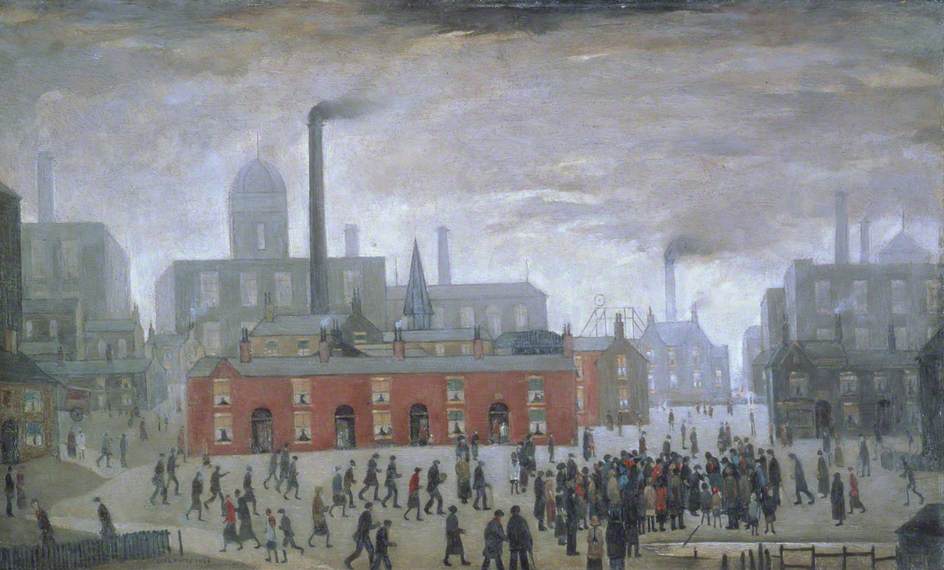
Photo via BBC
A mid-20th-century painter known for depicting northwest England, L.S. Lowry was famous for painting vast urban scenes with crowds of "matchstick men." Although he was popular, the art globe dismissed his paintings equally niggling for a long time. They couldn't have been more wrong. Similar a sadistic Where's Waldo, Lowry's paintings are filled with hidden flashes of homo suffering.
In his 1926 painting An Blow (pictured above), a crowd of people get together nigh a lake, looking at something hidden in their midst. While the painting isn't blatant about it, the scene was inspired by a local suicide and the group are meant to exist looking at a waterlogged corpse. His 1935 piece of work The Fever Van shows a group of pedestrians gawking at a van picking upward a patient. At the time, diphtheria and scarlet fever were widespread in Manchester and frequently fatal. The unspoken message is that the unseen sufferer in Lowry's painting volition virtually certainly dice.
Other Lowry paintings include people getting in fistfights, being evicted, or simply staring from their windows in overwhelming isolation. In each case, the tragedy is never more than than a background incident, almost subconscious in the painting. All the other matchstick men just keep on living their daily lives, unaware or uncaring of the suffering in their midst. The message is nosotros're utterly solitary and our pain means nothing. It'due south probably the nearly terrifying hidden message of all.
berryhatioubjece1995.blogspot.com
Source: https://listverse.com/2015/05/09/10-great-works-of-art-with-incredible-secret-meanings/
0 Response to "Ways People Have Interpreted Art Ways People Have Interpreted Salvador Dalis Art"
Postar um comentário